Dear Arturo,
I went to visit the mayor the other day to collect her drawings. Much to my surprise she was actually in her office. She had finished redecorating and she merrily showed off the painting which she chose to display opposite her desk. Yes, that one. Once she was done with her taunts we discussed some business and I left but afterwards I pondered the painting. When I returned to the estate, I went and found an old art curator’s catalogue in Lady Emrac’s collection.
One entry in the catalogue had been scraped out and written over again. I cannot make out what the original entry said but I found an odd letter folded into the the page. Lady Emrac was as surprised to find it as I was. The old paper of the letter had crumbled into pieces between the sturdy parchment of the catalogue so reading it took some work but I eventually managed to piece it together.
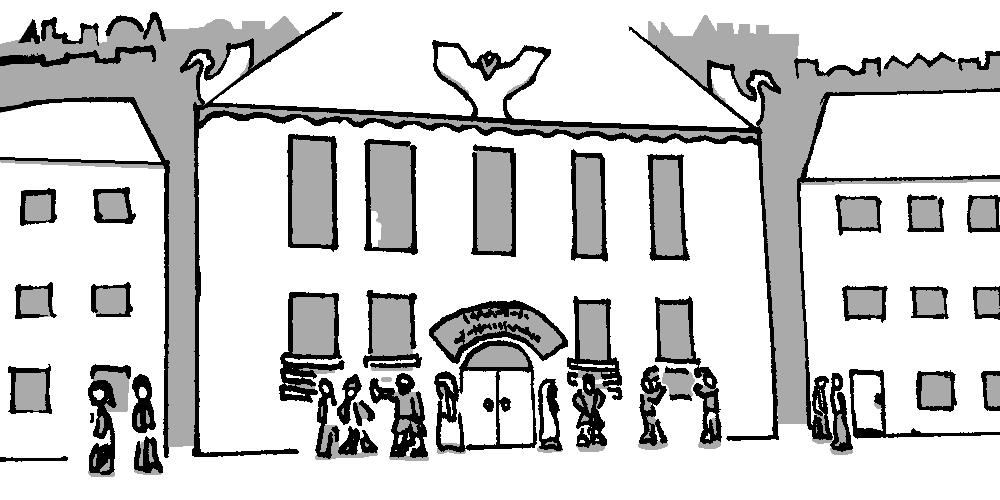
When I was a boy living in the eighth borough I once wandered down a busy street not far from the temple and saw a stately old storefront surrounded by priests and lawmen. The windows were being boarded up and traffic was driven away from the door. I asked passers-by what was happening but no one would speak to me. Finally a lawmen told me that the place was dangerous and drove me away.
After I returned home I told my mom about all this and she looked sad and said, “So they’ve finally closed down the old gallery. What a shame that is.”
I said, “The passers-by and lawmen wouldn’t tell me anything. What’s going on there?”
She said, “Your father and I used to visit there often. Templeside Lane Gallery was curated by a man who used to dine with nobles of the Hachneys, Hivornesses, and Hulls. He once displayed the finest works of the greatest masters – men and women who could capture on canvas all the sights and scenes of the city no less vividly than the eyes sees them. But then he began collecting twisted and obscene paintings – the kind that only a sick-headed man would dream up.
“At first he displayed them only in a room near the back. When he was chided for it, he began displaying them in the front. In time he would display nothing else. Fearing his collection’s theft or seizure, he handed the works off to his friends. And now his madness must have finally gotten the better of him.”
I asked her, “What were these paintings? Where did he get them from?”
She told me, “I’m not sure where he got them from but your father used to say that long ago there was a boy who longed to become a great master himself. Though not a Hull himself, his parents had some of their blood and some of their wealth so he studied for years under a respectable teacher.
“He became a master of light and shadow. He painted stone walls made wet from rain and he showed how they mirrored light from the torches lit in early evening. He painted the sky at early morning and showed how glare from over the horizon mingled with shadowy clouds moving in from the north. He painted scenes from forges lit up by flying sparks, only barely touched by daylight from outside. He mastered all these scenes and was set to surpass his teacher. Then his parents both passed.
“The boy could no longer afford his lessons and had to work in the forges he once painted. He had to rise in the early morning and walk home in the rain. But he did not give up his love for the brush. He continued his practice by night but could barely afford a single flickering candle to work by. His art suffered for it.
“One day he happened to wander down the road behind the temple and met a woman who cursed and grumbled as she hauled out sacks of old or broken wares to be thrown away or sold for parts. There were faded and stained linens, broken candlesticks, cracked glassware, and other such things. And as the boy walked by she tossed aside a brightly burning brass lantern. It was of the same splendid make that the temples are known to use and it was in perfect condition. Its flame burned on even as she tossed it aside and the glass shade was uncracked. The strange flame was of many mingled hues, unlike the white and blue which you see in services.
“The boy asked, ‘Lady, why are you throwing that away?’
“She said, ‘It is wrong, boy. It is a mischievous lamp. It burns when the priests tell it to go dark. It stays dark when it’s meant to shine. It is useless and I have plenty of better ones. Take it if you wish but tell no one where you got it. The priests ordered me to see it broken.’
“So the boy took the lamp home and that night he painted in its brilliant light, at once surpassing his old teacher. People took notice and soon he quit the forges and made his living as a painter of note. But his work only succeeded when he painted in the lantern’s light. He depended on it to speed his skill.
“Years passed and though his command of the brush became great his mind began to change. He dreamt vividly. He had strange visions of lands and creatures that were only real in his mind. Slowly he left off painting things of the world and began painting things that were only phantoms. He painted beasts with spectral fur, giant like monsters but with gentle and noble bearing that walked among men. He painted mansions decorated in loud burning colour with lawns and gardens of unreal flowers. Where before he had mastered light and shadow he now played with flashy pigments. His patrons fell away and his critics grew. He would only say to them,
“’I do not paint what is not. I paint what may yet be.’
“When the boy was an old man some priests heard of his lantern and how he got it and they accused the painter of being a pupil of the shadow god. The painter hid his paintings and the accusation was soon forgotten. He died comfortably one day, surrounded by a few trusted friends. Generations passed and the curator at the Templeside Lane Gallery got his hands on them and now it seems that they’ve driven him mad.
“Be careful then, my son. Dwelling on dreams and phantoms can be dangerous.”
My mother gave me this last warning with a kind smile as she looked me in the eye with a warm hand on my shoulder. I remembered that moment then and I remembered it years later after her death when I was sorting through her belongings in the attic and found the very paintings which you now see before you. You will find more in time. They have a way of showing up when the right moment comes.
Your grandmother told me to be careful. She said that dreams and phantoms were dangerous. But she never said that I should never dwell on them at all. Guard these paintings well, my son. You might make some of them real some day.
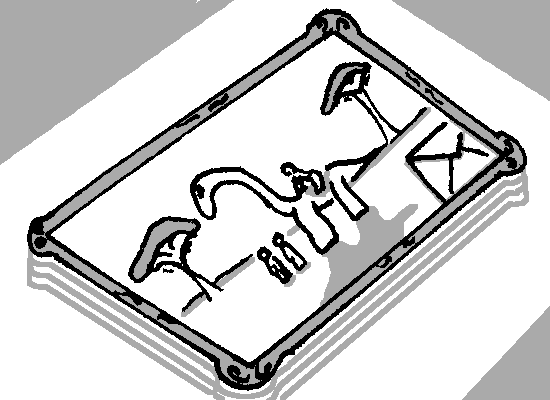
The author and recipient are unnamed. The Templeside Lane Collection was a real exhibit about which there are many legends. Supposedly the artist depicted the taming of the ashen dragons, the invention of the lightning tower, and even battles from the Ruckus all well before their time.
As unbelievable as it might seem, I wonder how much of our history was foretold on the canvases of that collection. And what images of our future we might find on those lost or yet-unrecovered artworks.
In truth, it makes little difference to me and my work but it does excite the imagination, does it not? And I am willing to admit that the mayor’s hall looks nice.
 geldorad.ca
Leave a comment