Arturo,
I regret having not written to you much lately. You can imagine the sorts of distractions and commitments I have to deal with which regularly pull me away from more fulfilling activities, such as sharing our history with you. I am glad to hear that you are well and all of us here remain happy and healthy, so I will dispense with pleasantries and tell you what you want to hear.
As it has been some time since I last wrote to you, I decided to break my silence with a longer story – though not as long as it could be. The tradition surrounding the champion Ronwyn of Daash began with the dry and tedious Longer Tale which I consider to be more accurate but less enjoyable to read. Copying it to send to you would take months. Instead, I would like to hear your impressions of the embellished Shorter Tale which describes all the interesting moments of her career and adds some compelling imagery.
I could provide you with a brief summary of how the two tales differ if you like, but read this as it stands for now. You may examine the Longer Tale upon your next visit if you feel the need.
Your tardy but dedicated friend,
Sidwid.
Ronwyn of Daash – The Shorter Tale
I – Of Ewel of Daash
While Lysseus was yet free of the great grey city’s law, there lived in the hamlet of Daash a champion named Ewel. Young Ewel was quick-tempered and harsh. Many a time, he fought with his brothers and stole from his sisters and his father’s grief grew deep. Ewel’s temper was unchanged on the day when the mayor of Lysseus visited Daash to inspect its walls and its watchmen.
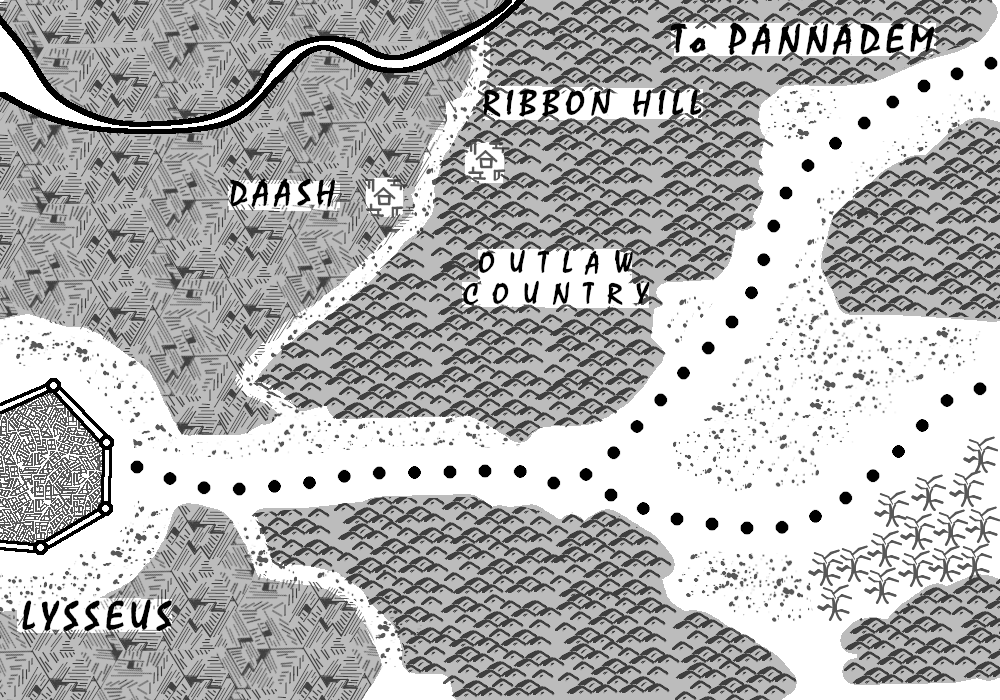
The mayor found the walls sturdy and the guards suitably stern but he looked with displeasure on the horizon where hundreds of hills stood empty and unchecked. Young Ewel was out fighting with his brothers in the road when the mayor passed by and watchmen went to drive them all away. As a guard approached, club in fist, Ewel at once picked up a stone and flung it at the much bigger man’s head. The helmet flew off and fell to the ground and the man himself fell to his back, dazed and dizzy. Others came and bound Ewel and carried him away while his father apologized to the mayor.
The mayor said, “Daash will stand even if Lysseus falls when men like your son learn to fling stones at the hills and not at the helms of elders. Let our foes not make camp at your doorstep and you will not need these walls, sturdy through they are.”
Ewel was trained from that day and grew into a mighty man of battle. It was well that he did, for this was the time when two dire threats came against the people of Lysseus and its outlying villages. One was the Bloodeaters’ Plague which drove man against his neighbour in hungry fury. Pannademian iron kept the bloodeaters away from Daash for a time but every year they came closer.
A far greater threat was the Gafol Row, begun when the great grey city of Geldorad demanded tribute from Lysseus and obedience to its laws. The city’s nobles found Lysseus’s mayor unbending and instead sent lawmen and publicans to the outlying hamlets which gave tribute out of fear. So it went until they reached Daash. Ewel had trained his slingers on wilderness beasts and wights, bloodeater scouts, and plundering outlaws. A hundred city lawmen, softened by the cowardice of other hamlets, were a fitting challenge for Ewel and his slingers. They harried them in the fields and bravely drove them from the walls. The attackers scattered into the wilderness and many were taken hostage. Daash’s fame stoked the hearts of many hamlets who then threw out the city’s lawmen and swore fealty to Lysseus once more.
In his wintering years Ewel’s neighbours had a grand statue of him carved and set up along the road. It stood as tall as the tallest roof and watched over any who passed through their land. He died and was laid to rest at eighty years, and in Lysseus an armoury was build which bears his name to this day.
In his time he saw Lysseus withstand the city’s threats and bargains and brought fame to his people. Ewel of Daash was a mighty champion.
II – Ogerda’s Husbands, and Ronwyn of Daash Celebrated in Ribbon Hill
Ewel fathered Ogerda who grew into a mighty champion in her own right. Ogerda was less reckless than her father but her aim with a sling was just as sharp and she fought foes well beyond the hills east of her home.
While the Gafol Row slept for a time after Ewel’s brave stand, it was not over. Nobles of the great grey city sought ever to bring the other towns under their protection and under their law. Terrodrad followed the city willingly and Issodel lacked strength to fend off beasts from the woods, much less the city’s lawmen. Pannadem made their own offer to the city which their nobles accepted. Lysseus was left nearly surrounded.
Bordering Daash, itself on the frontiers of Lyssean land, was the Pannademian village of Ribbon Hill. While Daash brought ample harvests to their mayor, Ribbon Hill offered ore and metal to its newly chosen reeve. Daash and Ribbon Hill had traded in bygone days but now the road between them was quiet.
While Ogerda was but a young woman, lawmen and publicans again moved across Lyssean land. They launched their extortion efforts from Ribbon Hill. The villagers there were happy to host the city’s messengers but refused to join them when they marched down toward Daash. Ogerda learned of their march early and harried them in the hills. She drove them back whence they came and proved herself a worthy heir to her father’s title.
Ogerda married Eroughel, a clerk for the Lyssean Council. It was Eroughel who first brought together all the town’s laws and statutes and removed those laws which disagreed with each other. He was wise and clever and a worthy husband to Ogerda. They had a daughter and named her Ronwyn and the three were happy together for several years until a time came when Eroughel fell painfully ill and Ogerda was wounded in battle. Illness and injury strained their marriage. Words were spoken which both would live to regret.
Among the insults Eroughel said,
Eroughel insults Ogerda
“Lover mine, whose limbs lost their better use
To brutes’ brawling, embrace if able
My hurting head, or hunger-pangs slay
With suppers’ sword-play. Sorrow upon her
Who neither need may neatly serve!
What waste is woman who wades into war.”
Their marriage failed and Eroughel returned to Lysseus.
Ogerda then married Merl, a watchman of Daash and a student of one of Ewel’s slingers. While Eroughel was thoughtful and gentle, Merl was hasty and fierce. He trained his step-daughter Ronwyn in the use of a sling and taught her the proud defiance of her grandfather. Merl and Ogerda had a son and named him Uuric. Being the younger child and often kept from battle with beasts or outlaws, he grew to be fond of reading and record-keeping.
Ronwyn would return from battles and hunts and mock her young half-brother saying,
Ronwyn insults Uuric
“Words I can whip as well as sling-stones.
My aim unerring at Uuric strikes.
Silent he sits, sad and frail-armed.
Utterless Uuric: Heir to a father
Abroad and brave, half-brother to one
Who looks (unrelated) more like his dad.”
Uuric bore his half-sister’s taunts in silence, hoping to shame her with his forbearance. But Merl grew impatient with his son who seemed to lack strength to defend himself.
While Ronwyn was still but a child, news came that Ribbon Hill would soon fall under attack by the bloodeaters. The city’s lawmen had left the village months ago and there was no one there to protect them. Daash’s elders petitioned their mayor and asked permission to abandon their hamlet which would surely fall after Ribbon Hill. The mayor agreed and the people made ready to leave, for a time or forever.
But Ronwyn would listen neither to the mayor, nor to the hamlet elders, nor to her own parents. Three days before they all were to leave and seek shelter in Lysseus, she slipped away in the night with sling in hand and flew up the road toward Ribbon Hill. There she found the villagers hiding and helpless.
That night was a night spent valiantly. Fifty bloodeaters and their thralls and beasts crawled through Ribbon Hill’s streets. They broke windows and beat down doors. They took cattle and pets and drained them. Fences burned and towers crumbled but amidst the clamour Ronwyn of Daash rose defiant. She knocked the brutes down one by one, landing stones deep into their skulls. Even as her slinging arm ached she fought on and her aim never faltered. She single-handedly fell each of the bloodeaters until only the last and strongest of them remained. His stolen blood was also scattered on the rocks.
Ribbon Hill’s villagers crawled out from hiding and spent the rest of the night dancing and singing their victory. Their elders lavished Ronwyn with gifts – bronze shields and brass buckles, iron tools and trophies of tin, gem-studded goblets and cups of coloured clay – and they praised her, calling her the Hero of Ribbon Hill and Champion of the Frontier. At the first light of dawn she set out back home.
Ronwyn’s absence was noticed in the early morning in Daash. Many were out looking for her and beginning to fear for her life when she was seen coming down the road from Ribbon Hill. Her family went out to meet her, meaning to scold her for acting without permission. But they saw her many decorations and gifts and listened to her story with wonder. Ogerda and Merl lifted her up and bore her back to the hamlet with pride.
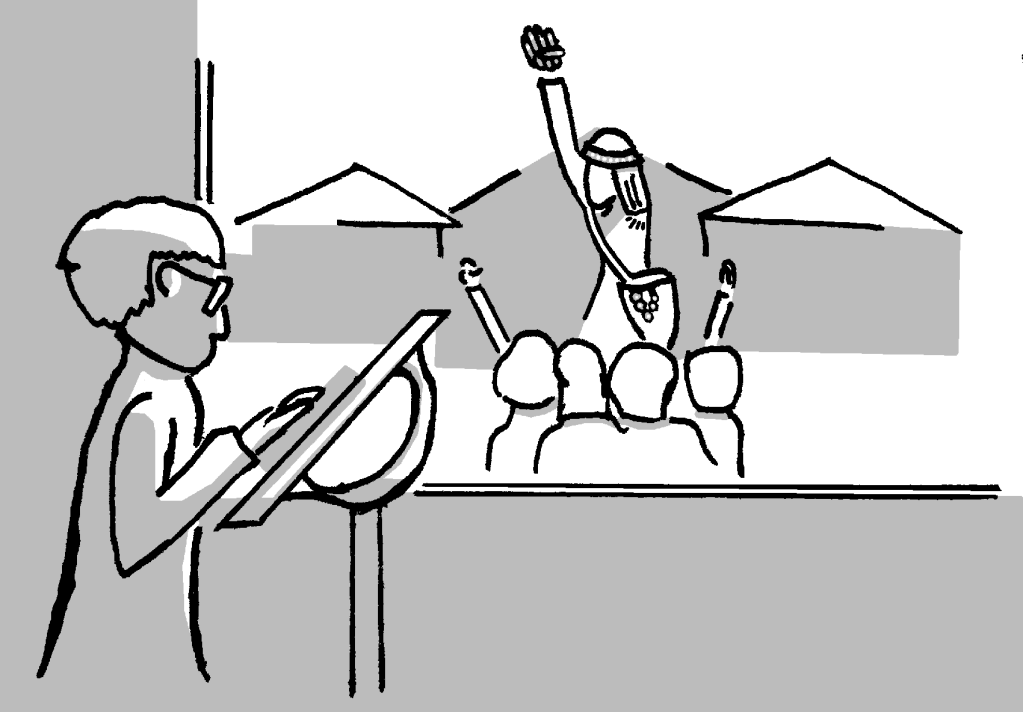
During the celebrations, Uuric spoke to her gently and said, “I see your brashness can be of good use if set against the right target.”
Ronwyn was more sore and more tired than she had ever been before. She replied, “This world has enough foes that I need not waste another stone or insult against you, my brother.”
Though it was not the end of their squabbles, the two siblings were on better terms after. Ronwyn’s strength and fame grew over the years and Uuric became the hamlet’s reliable notary. A day came when Uuric was called away to Lysseus to meet in council with clerks and notaries from other hamlets and villages and Ronwyn bid him peace and safety as he left. His return proved not so happy.
III – Ronwyn Defends Daash and is Exiled
Lysseus gave itself over to the great grey city. The town’s mayor became its first reeve, loyal to the Mayor of Geldorad. The great grey city achieved through debate and argument what it could not achieve through force. They reached an agreement with Lysseus which most thought fair and generous.
Merl’s wrath turned on Uuric. He insulted his son but Uuric showed courage and spoke up for himself.
“I fought hard to safeguard our freedoms,” he said, “I and many others. Were it not for my effort and Eroughel’s leadership, the city would have taken much more! In time they would have brought us down through arms and taken everything, but now we have some freedoms written in their own law.”
Ronwyn was glad to hear of Eroughel’s well-being, but Merl’s cheer was dampened for the rest of his days.
When Ogerda was laid to rest, the title of Champion passed to her daughter Ronwyn. The skill of Daash’s slingers was unmatched in her time. She dealt the treasures of Ribbon Hill to the best of her volunteers and carried many herself out in the hills where she fended off worms and highland wights.
And in those days her fame spread and she boasted,
Ronwyn’s Boast
“Other ones may ask that orders be sent,
Wait for the word. No will have I
To let Lysseus - law-headed dolts
From far-off fields - defend my home,
Command my men. Mettle-less clerks
May know nothing of near-drawn foes.”
Meanwhile, Ribbon Hill thrived for years and made good use of their neighbour’s protection. Vast veins of copper were found in those years and twenty cartloads of ore went out to Pannadem every day. At times they uncovered god-fossils and sent them north. Daash also thrived, for Ribbon Hill could not grow their own food and bought up great stores from Daash. The two villages grew close in friendship and the road between them was oft-travelled.
Then there came a time when the bloodeaters grew powerful once more and attacked Ribbon Hill without warning. A mob of one hundred came swiftly in the night along with their beasts and thralls. Ribbon Hill’s watchmen stood bravely besides some of Ronwyn’s slingers and cut down more than half of the foes. They earned highest renown that night but bought it dearly. When morning came the stripes of Ribbon Hill were stained red.
Uuric went out to Lysseus and returned the next morning, bearing the reeve’s command.
He said, “All the villagers of Daash are to pack up at once and set out for Lysseus before midday. There will be no battle for Daash but in Lysseus all will be safe.”
Sullen-hearted Merl followed his son’s command but Ronwyn roused her slingers and said to the people,
Ronwyn Fights
“We fought fiend-hosts for folk out east
But run wretchedly as ruin now comes
Here to our home? Hardly! But return
When night is nigh to nap safely
In better beds. Nightmares will fall.
Your cowards’ quarters in calm will stand.”
Uuric spoke against his sister and said, “This is not the hamlet elder’s command that you plan to defy, but that of the reeve chosen by the lords of the great grey city. If you must stay and fight, I will return by nightfall but the people of Daash will not.”
Ronwyn ignored her brother’s warnings and stayed behind as her people set off for Lysseus. Some time after midday the bloodeaters attacked and Ronwyn crushed them. She and her slingers struck them as they crawled over palisades and knocked them down as they ran through the streets. They chased them out of their home and pursued them into fields and pastures, wetting the soil with the stolen sweat of battle. Ronwyn drove the bloodeaters from that land, never to return.
When Uuric returned that evening Ronwyn was surprised to see him come alone. He looked over all that his sister wrought and said,
“I will have to tell the reeve all of this. Will you go to town with me or will you stay?”
“I will stay,” she said.
And in the morning Uuric left. Five days later he returned, again alone, and with a heavy heart he declared,
“This is the word of Lysseus’s jurists, and of the reeve: ‘Blemished blood has fallen on the fields of Daash and tainted its ground. For twenty years, nothing that grows there will be safe to eat, nor must any beast be allowed to graze there. Had no battle been fought in Daash, its people might have returned in months or weeks. But five years of outlawry are assigned to Ronwyn, Champion of a hamlet which may no longer exist. She will live without the law’s protection, and none will shelter her for five years.’ The reeve demanded twenty, but I managed to lighten your punishment. I pledged on my own good name that you would keep the marches safe until your punishment ended.”
Ronwyn cursed Lysseus and cursed the mayor of the great grey city. She bid her brother farewell, sincerely but without cheer, and set off into the distant marches. Already the fields around her home began to turn black.
IV – Ronwyn Plunders Weapons from Pannadem
Bandits and outlaws roamed the hilly marches east of Daash. Their numbers were much greater in the days after the towns accepted reeves from the city. Ronwyn avoided them for a time, honing her skills at fighting in narrow valleys and cramped clefts. She fought lesser worms, packs of maddened beasts, and murderous hags. Other outlaws took note of her work and a day came when she found herself their captive.
The outlaws’ company was welcome to her after months spent alone. She told her story to her captors and proved her skill beyond doubt. They made her one of them and she fit into their band quite well – a gang of thirty who reveled in taking from those who banished them. They said that Ronwyn’s arm was as good as three and she rose in their esteem.
One morning, in a season when their company was low on tools and weapons, their captain summoned them and said,
“We have heard of bloodeaters making grim pacts with worm-herding hags. They will drive toward Lysseus and pass through our land. For this reason Lysseus has bought weapons from Pannadem which are now in transit. Their caravan will pass near. We will take their weapons and defend ourselves against the bloodeaters.”
Ronwyn asked, “What of Lysseus? Will they not need weapons?”
The captain said, “It matters not to me if Lysseus falls, but they will endure. They now have Geldorad’s weapons and fighters. It is only to ease the battle that they buy from Pannadem.”
Ronwyn and the other outlaws found the caravan and waylaid them. Their guards were easily overpowered and bound. The traders pleaded, saying that the weapons’ maker had been taken by a swarm of bats and all his notes with him. More of his arms could not be made unless they were studied in Lysseus.
Inside their carriage, the outlaws uncovered spring-bows powered by the gods’ rocky flesh.
The outlaw captain took no heed of the traders’ pleas. Some of the outlaws wanted the traders killed, but Ronwyn challenged them and argued for their lives.
Defending the Traders
“No worse a work the weak townlings
Could so coldly carry out on us
Than ban our abiding. No better vengeance
Than proving prudent in praise-worth deeds.
Spare spilling their blood. These spoils are ours.
Enough are these arms. Their own are their lives.”
The captain sided with Ronwyn and sent the traders away with their guards empty-handed. The outlaw band would cover their departure against the coming worm-horde. Ronwyn and her companions made their stand on a quiet hill and watched the horde heading for Lysseus. One of their savage companies broke off from the rest to attack the lonely outlaws.
Spring-bows came to life and launched their darts with heaven’s might. The worm host and their hag drivers fell to bolts which flickered with starlight. Ronwyn with her sling and dull stones fell just as many as these heavenly weapons. Surviving fiends fled, much worse for wear, to rejoin the ranks now hasting to Lysseus.
Thus the outlaws defended their land.
Days passed. The outlaw band had not the skills to keep their godly weapons alive and soon they broke. Their parts were made into new weapons which served well enough. Ronwyn with her sling had no need of them.
After a time spent roaming the hilly marches in search of straggling foes, Ronwyn returned to the outlaw camp and heard of a lone wanderer who was taken captive. Her companions took her to the place where the captive was held because he had asked for her by name. She was led to the place where her brother Uuric sat bound up in rope. Chastising her companions she untied him at once.
The outlaws objected, “He is one of the reeve’s clerks! We should hold him for ransom!”
But Ronwyn ignored them and untied Uuric all the same. He spoke to her in the presence of the others.
“Thank you for untying me, Ronwyn. But I’m afraid I was sent to tell you that heavier bonds have been placed on you. The battle at Lysseus went poorly. Without the arms which you stole, we were unable to repel the worm horde before they broke the town wall. Hundreds died who otherwise would have lived, and the traders you robbed told everything to the reeve. He will now not let you return to Lysseus until fifty years of your exile have passed.”
At this news, the outlaws fumed and cursed to one another, saying, “It is well that the watchmen of Lysseus died! They who banished us to defend the marches now dare punish us for following their orders? Let them all rot!”
But Ronwyn mastered her anger and spoke gently to her brother. “I know you take no pleasure in telling me this. I would rather learn this from you than any other.”
Uuric then said, “I must tell you another thing which brings me no pleasure. And because I know you are stronger than me I will tell it to you plainly. Eroughel was among those who died in the attack. Your father is gone.”
Uuric returned safely to Lysseus and that evening the outlaws laughed angrily over tales of the town’s misfortune. But Ronwyn would not join them and kept to herself.
V – Lysseus Casts Out Its Rescuer
Months passed and the third year of Ronwyn’s banishment began. For her strength and brave deeds, she was lifted up among the outlaws until only the captain stood above her. She followed his command in everything and all in the company looked up to her.
One day she sent out a team to scout the hills to the east and when they returned they reported that a host was assembling in the hills, a host beyond anything ever seen. They counted five hundred bloodeaters with one thousand thralls, twelve terrible hags with eighty four disquiet wights as retainers, and a host of feral beasts besides. They had with them a swarm of fifty lesser worms, each rising to a man’s height, and three ancient worms of the misty woods as tall as cottages and with scales like flagstones.
The scouts reported that they were making ready to head straight for Lysseus and would not bother with the outlaws’ domain.
The captain laughed. “Then Lysseus will fall! And when Lysseus falls, no longer will anyone remain to keep us prisoner in this barren wilderness. At last those cowards who bent to the city in the west will meet their end. All we must do is wait.”
Ronwyn said to him, “If their watchmen and the city’s lawmen fight poorly, the three ancient worms may come for us after. And if we must die, should we not cast spite aside and die as one?”
The captain said, “When Lysseus is but rubble, we will be tied to this land no longer. We will go where it is safer and leave the worms to revel in the town’s ruins. But wherever we go, we will not go to Lysseus. I forbid any one of you from lending aid to our hated foes.”
The other outlaws agreed, or at least appeared to agree. And Ronwyn appeared to agree also. But in the early morning, well before dawn, when the outlaws’ watch was at its weakest she crept away and fled through the wilderness, not to Lysseus but to Ribbon Hill. There she scrounged through the ruins of warehouses and collapsed mining tunnel mouths until she gathered ten small god-fossils. They burned her hand when she touched them, as the blood that was shed there years ago awakened and angered them.

On the dawn of the next day she left Ribbon Hill and ran through the black fields of Daash. She did not stop to visit her empty home as she made her way swiftly toward Lysseus. As she ran up the final hill before Lysseus she heard the clatter of battle echoing through the air, and reaching the crest she looked out and saw a terrible fight unfold. The three ancients battered against the crumbling wall and watchmen were shaken off their feet.
Ronwyn, Champion of Daash, leapt down the hill like a falling star and loaded the first stone into her sling. A host of feral beasts came to meet her but she cast a stone into their midst and it landed with a great fire that burned them all to ash. The second stone she loaded as a band of wights came at her, and she fired the stone through them that cast their ghostly forms to the wind. Three of the hags came at her next and a third, fourth, and fifth stone silenced their sorcery. The sixth and seventh stones were for the bloodeater rear-guard and their thralls. They were swallowed in starlight.
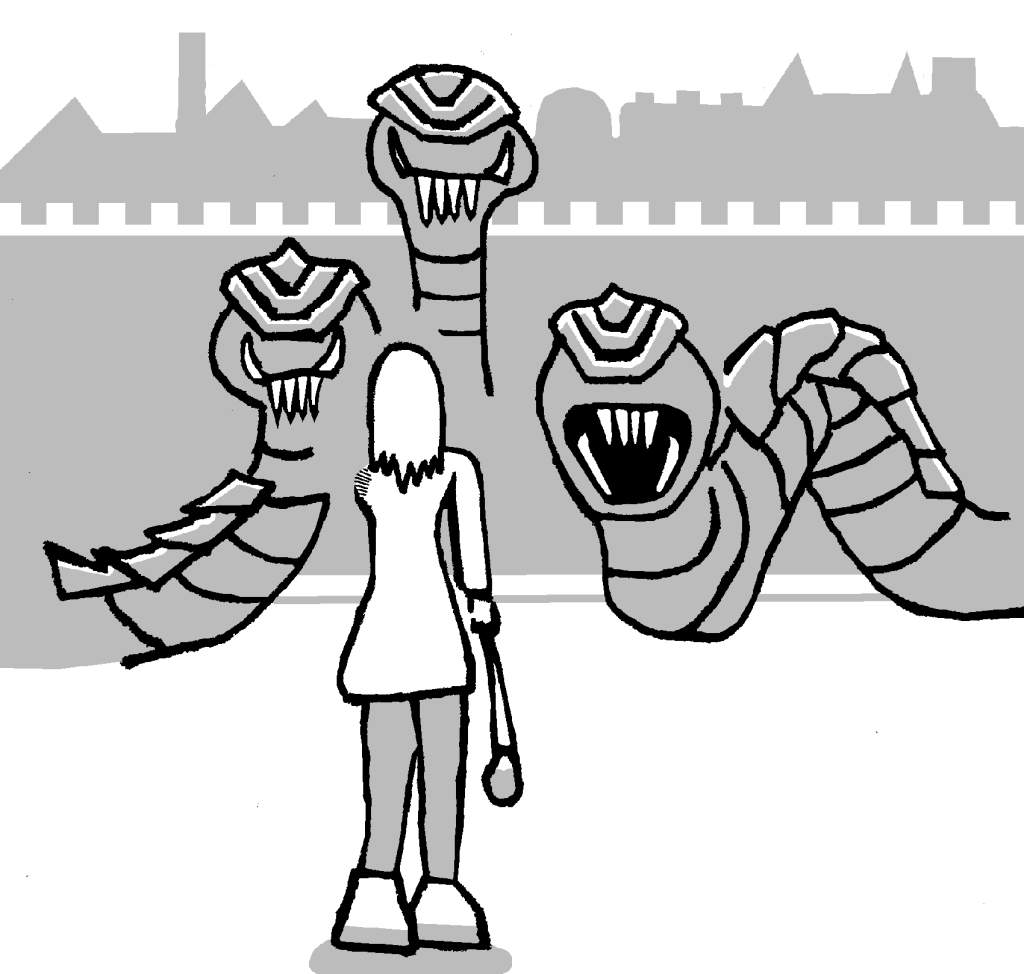
And at last she approached the three ancients. City lawmen kept the lesser worms at bay while Ronwyn loaded the eighth fossil. An ancient worm of the misty woods lunged toward her and she shot forth the stone which such force that it passed all the way down its body and through the other side. The ninth stone hit against the second ancient’s skull as it tore at the town wall and a flame brighter than the dawn engulfed its head.
The tenth fossil she loaded into her sling and she aimed toward the last great worm and with all that was left of her waning strength she let it fly. For the first time in her life, and the only time in her life, she missed.
But victory was now within reach and in the hours that followed the watchmen of Lysseus and lawmen of Geldorad wounded the remaining worm and drove it back into the hills. The rest of the attacking host scattered and generations would pass before so horrible a force came again as far as Lysseus.
Uuric found Ronwyn on the field outside the town, alive but injured. During the fight her feet had both broken and become mangled beyond recovery. Uuric lifted her up to take her into the town but an outlaw was not permitted to enter. She was treated by the town gate instead as Uuric went to meet with the reeve and his aldermen.
He returned in the morning and said, “I have been sent to tell you this. ‘For saving Lysseus in its hour of need, the Champion of Daash will no longer bear the exile of fifty years which we allotted to her. Only her former term of five years will remain and two of these have passed. If she survives these in good standing, we will then welcome her back as Champion of Daash, and Champion of Lysseus’.”
She said,
Honour
“Such feeble fealty and fickle honour
Have I thus held. Hastily changing
Is man’s mood-wind. Tomorrow’s vices
Are never foreknown, now called virtue.
How long will last these loaned honours?
All my actions ever from birth
Seemed sound to me. I sought the right.
Rewards I won which waned after.”
Uuric said, “Truly the new law makes little account for old custom. This will have to be fixed. Since Eroughel passed, I have become one of the reeve’s chief jurists. I promise that I will see the new law set right in Lysseus, or else our honour will fade and our esteem be counted nothing.”
“That would be best,” said Ronwyn. “But I will have no part in it. I have lost enough and now I cannot even walk without these crutches. I hope to see you again and often, but it will not be in Lysseus. For now, my place is among the outlaws.”
Ronwyn hobbled through the fields and hills until she drew near the outlaws’ domain. Before she could enter she was met by a group of them and they would not answer her greeting.
“Be gone,” they said, “Friend of Lysseus. There is no place here for those who help our oppressors. Go and die in service to the grey city.”
Ronwyn said, “I will not die, but never again will anyone hear the name Ronwyn of Daash. There is no place for that name anywhere. I will wander the world, meek and meagre, and live off the land. But know that the worm I could not slay will swallow you and your names will go unwritten.”
In the years and decades that followed, legends grew around the Footless Fury of the Hills who often saved wayfarers on brink of death. Uuric of Daash never said a thing about these tales but he often left on long journeys into the east and returned in safety and good spirits. Uuric achieved much as a jurist. He rewrote the town charter to make it fair and pleasing to all parties and wrote the bylaws which are used to this day. Uuric Lawhouse was built in his memory in later years and now stands across from Ewel Armoury, both at the head of Daash Street.
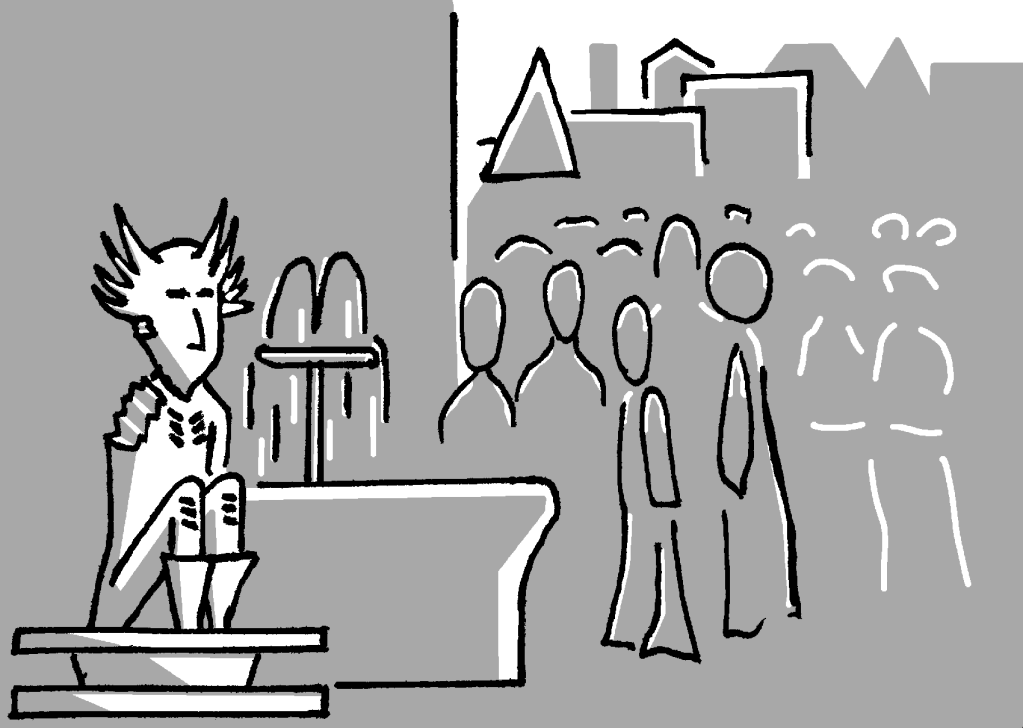
But for Ronwyn of Daash there were no monuments or memorials, only the tale of her rash daring. Some say that the statue beside the fountain next to Uuric Lawhouse was meant to be the Footless Fury of the Hills, but whether this was Ronwyn, daughter of Ogerda, daughter of Ewel is a truth that can never be known for sure.
Here Ends the Shorter Tale of Ronwyn of Daash
Arturo,
I anticipate that you will ask whether the Fury Statue survived. It did not. But Segrin of the Stone Commune plans to build a replacement.


Leave a Reply