Dear Arturo,
What you are describing sounds little worse than a common cold to me. Perhaps its intensity earns it the title of Uncommon Cold, but I have no reason to doubt your physician’s calm assessment. I do have reason to doubt that you could have brought any of our worst ailments back home with you, and our friends the priest and the witch agree. They send their wishes for your quick convalescence, by the way.
I cannot suggest treatments with any authority, but I can offer that which I’m sure you most expect from me by now. An occupied mind is good for recovery, as are reminders of how things could be worse. I hated this tale as a child and have only lately had the stomach to try examining it again. You know me well enough to guess why. Putting aside my personal displeasure, it does seem to be the type that you and many others may enjoy.
Here it is.
Before the second great Rough Rash outbreak, settlers on the southern isles watched in envy as ships sailed out from the city to make their catches day after day and year after year. When the sea was safe, men of the city went out and returned with splendid hauls. Whenever terrible storms or wave-thrashers approached, the Voice of the Storm let out a warning call and sailors returned to safe harbour.
So it was for the city, and around the northern isles storms were more mild and sea-prowlers more rare. Boats went out from there often. But down on the mouth of the river Munwin storms came up suddenly and there was no voice to warn them.
A great rock stood above the southern waves in those days, rising up between the outer isles and the Terrodran coast. Little grew on it, but it was wide and sturdy and birds visited it daily. A sailor named Gerath looked out at that rock from his home on the southern isles and thought to himself that a stronghold should be built on it. There men could watch the sky and sea and give warning when danger came. His neighbours liked the idea but none would volunteer to settle there.
“It would be a hard life,” they would say. “You’d have few friends, or the place would get too cramped. You’d have breakers beating ‘gainst your doorstep day and night. And whatever you couldn’t catch or grow you’d have to have rowed over from the shore.”
Gerath grudgingly agreed. “Aye, it wouldn’t be easy. But if any decide to settle out that way, I’ll be the one to ferry their needs over.”
Gerath proved true to his word not long after. A plague struck the southern isles – the Rough Rash, which left its victims’ skin patchy and coarse. Some recovered slowly while others made no progress. They were kept apart to keep the plague from spreading. The isles’ elders came up with no better ideas than to ship the stricken victims to the island which became known as Sick Man’s Rock.
A long boat was built that Gerath could steer while remaining apart from the afflicted and he brought over the first settlers to the island. A second ship went out loaded with tools for building and it was captained by a plague victim named Ithuneth. Ithuneth was a young man and had been handsome before he caught the rash. His father had been the wealthiest man in the southern isles but he had died at sea, leaving vast wealth to his son. Before the plague wracked his noble features, Ithuneth was the favourite of all the young women of the isles. But now he was a wretch and an outcast.
Ithuneth laid the foundation for a sturdy stronghold and Gerath returned. He took up his dwelling in a newly built tower along the southern shore.
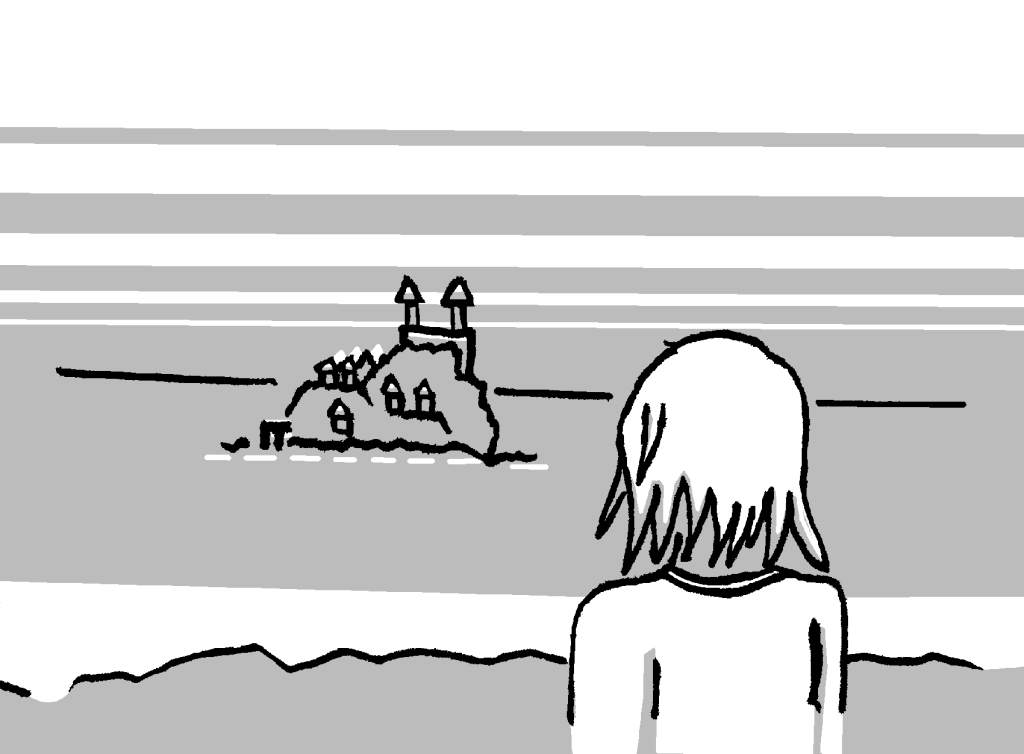
The stronghold rose quickly and soon the southern isles could send out fleets of trawlers to cast their nets safely into an unharvested sea. Eels and whales and sharks and clams came into the harbours faster than any could handle, and if danger drew near then mighty horns would sound from Sick Man’s Rock and bright beacons would burn. The southern isles quickly grew rich.
But Gerath continued living a modest life. At least once every month he would row out to speak with Ithuneth, sometimes bringing new plague victims with him, though fewer and fewer now caught the disease. Ithuneth asked only for cloth and salves and new tools at first, but in time he demanded more and more – stately furniture and luxurious clothes, choice meats and rare brews, even jewels and gemstones. Ithuneth threatened that if he was not given what he wanted he would cease warning the sailors of storms and sea-drakes and leave them to die on the waters.
The elders of the southern isles had no choice but to grant Ithuneth what he wanted. Gerath delivered his demands and noticed that when other settlers came to receive his tributes they spoke not a word but served Ithuneth fearfully.
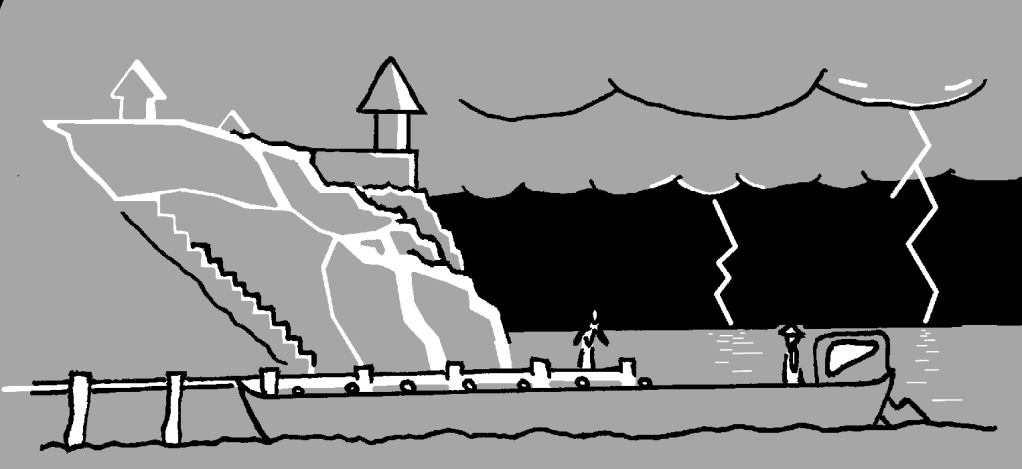
Almost a year after the the island was settled, Gerath rowed out one night and waited quietly by the shore. He had arranged to speak to one of the patients in secret and was relieved when the sick man arrived.
Gerath asked, “Tell me the truth. What is wrong with Ithuneth? What has he done to you?”
The patient said, “He thinks that he is the god of this island. He never leaves us alone for a moment. His cronies are always watching and they hit us when it pleases him. You cannot imagine how much it hurts.”
“What made him turn out this way?” Gerath asked.
The patient said, “You would not do much better if you saw what lies in the deep beyond. Ithuneth looks through the waves and sees what awful un-creatures lurk at the world’s edge. ‘We and everything we know are but a morsel dangling above an unending maw, a great nothing filled to the brim with endless snappers.’ That is what he says. The rest of us see thrashers and angry storms but nothing like what Ithuneth sees. By day he bellows but at night I hear him whimper.”
Gerath asked more about Ithuneth’s abuses and then stole back to the shore unnoticed. He relayed this troubling news to the elders who spent days doubting how to handle it.
On the eve of the first year’s end since Sick Man’s Rock was settled, the horn blew and the beacon flashed and all knew an awful storm was coming. Gerath looked out from the safety of his tower as waves around the rock grew taller and taller. Lightning flashed. Horrible roaring winds thundered over the water. Gerath saw one final wave rising up over the horizon, taller than the tallest mountain but slow like massive creeping serpent, and it swallowed up the final light of dusk.
A thick mist rose up and he could see the island no longer.
In the morning he sailed out to make sure the island’s residents were alright. He called out to them from the dock but no one answered. Covering his face with a mask he dared to step out onto Sick Man’s Rock and looked around for survivors. He found garden plots and simple huts, all destroyed and soaking wet. He found ruined silos and shattered fishing boats but not a single body, not until he opened the doors to the stronghold on the heights and a great flood washed out the door.
Inside he found some of the patients, all dead. Bodies of long-toothed eels lay strewn all about the flooded hall. On a silver throne, covered in jewels and colourful robes, sat Ithuneth’s bones.
The Rough Rash passed and no new settlers were found for Sick Man’s Rock. The waters of the south grew dangerous once more and could no longer be fished safely. Gerath moved back to the southern isles where he lived out the rest of his days in modest comfort and watched as more and more of the island eroded year after year. By the time he passed away, it was gone.
So ends the tale in its oldest form. A number of guesses have arisen as to what exactly happened to the island and its settlers. None of these can be proven or traced to a trustworthy source, but a popular idea along the coasts is that Ithuneth made a deal with a monster of the outermost sea. The earliest recording of this theory is as follows-
Ithuneth eager For exile’s close
Looked from his land Locked by seawave,
By rage-waters ringed. Rowmen set out
From dim dockyards At distant shores
And hastened to havens Hateful and grey
When stern stormclouds Stood against them –
Men merciless Who made him leave,
Ailing Ithuneth. Uneager was he
With throeful throngs To thrive when healed.
Wind-worn was he Those weary seasons
Out on the ocean. Over the whale-road
Light land appeared Leafy and fruitful,
A far fastness And fair vision
Whose hoary heights Unharmed by saltwave
Promised profit. Proudest Ithuneth
Set out at sea. The city vanished.
His rain-worn rock, Rueful and wet,
Shrank, enshrouded By shrieking spray.
Before his foot Could fall on the island
A voice most vile Reverberated
From darkest depth. Damp was his mood
As Ithuneth’s ear Opened to hear.
“I hated the Highest, Held ever friendless.
Lordless living Was lovely to me.
No Thane of Thester, No Thorn-mother’s son
Would I welcome. Waves I embraced,
Baleful abyss – That boon to freedom
Fetched up my form, Enfolded me.
Swell swallowed me. No sway had time
Or sickness since I sought the deep.
Fame I forged here, Fastitocalon.
I now offer you An exile’s close.”
Ithuneth answered, Ire-hearted man
“Grant, O great one Greedy of maw,
This promised prize! This prey I offer:
Souls sickliest Sitting idly,
Wasting away. Wondrous Thrasher,
My hovering heel I hasten this day
To plant in pledge And place my boot.
On scaly skin. My skull is yours.
Wreath it in ruin, Rest me below.”
His fangs fell then, Fastitocalon’s,
On ill Ithuneth. Eel-broods rounded
The ailing island And ate in fury
The pained perils Of poor sufferers.
Under ocean-tides Ithuneth now sleeps.
A later writer has reduced this verse to a cautionary tale for children and added,
Seek no solace From salt-waves’ realm.
On banks’ boundaries Abide you safely.
Swimmers may swallow No soil’s tillers.
If I may suggest a moral for you, Arturo, it would be this – a few weeks of discomfort in bed with friends nearby to serve you is an easy sentence compared to banishment to a far-off rock, hard service to a rough master, and final death from eel attacks. And I have already seen you survive far far worse than either fate.
If you do survive, I will look forward to hearing from you again.
Your friend,
Sidwid Hull.


Leave a Reply