Dear Arturo,
You asked me for stories about Ansyne, but the best of her tales are not really about her. The recorded episodes of her life treat her with the same lack of attention which many of her peers did – a sad reality which anticipated a happy resolution that would only come much much later. If you wish to write songs about Ansyne, I can provide you with some material but you will have to imagine a lot for yourself.
The more interesting thing to look at is Ansyne’s suitors and how they are portrayed. Early stories praise her admirers’ brave deeds. Later generations read selfishness into those heroes’ actions and considered Ansyne’s loneliness. Some tales offer a mixed perspective. To illustrate this, and to give you material for your songs, I will pass on two of these stories to you.
Ansyne, Abiryed, and the Two Wicked Suitors
A true tale of Ansyne, Mirror Bright of Heaven’s Charms, Holder of a thousand hearts, Whom all the world would win.
At the end of their time living in Pannadem, Ansyne’s father grew ill. Ansyne arranged to have her family move to the hills where the air was cleaner so that her father could recover. When they arrived in the hills they were taken in by a man of wealth and noble bearing who had his servants look after them.
Now Ansyne disguised herself so that no one would recognize her or be charmed by her beauty. She feared that if she were discovered then the servants would give her all their attention and pay little heed to her father. So she kept to herself in her room and spent her days spinning or weaving or reading. But as time went on she grew bored and plied herself to writing songs and then to singing. It was this last pastime which drew to the attention of two young men.
Eedy and Yarmly were fast friends from boyhood and each was handsome and well-liked. Eedy was the son and heir of the nobleman who was now Ansyne’s host, though he was made to work so as not to waste his father’s wealth. Yarmly’s father was of low birth and wasteful, though Yarmly himself lived well by his own effort and wit. Many a maiden living in the hills had tried winning the hand of either young man but Eedy and Yarmly were proud and refused them all.
Hearing Ansyne’s lovely voice from her window, they resolved to find out who this sweet stranger was. In an hour when they would not be noticed, they fetched a ladder and made ready to climb up to her window to see her.
But the stars would not have their precious daughter fall into the hands of proud schemers, so they sent the young watchmen Abiryed to them and when he saw their mischief he questioned them.

“What do you think you are doing?” he asked.
Eedy and Yarmly answered, “You must have heard the visitor’s voice and wondered who she is. All we will do is catch a glimpse of her. No more.”
Abiryed was not always the most diligent watchman and he decided to overlook the young men’s misdeed and leave them be. After all, it would not work out well for him if he made himself an enemy of these two famous boys. But he did decide to watch them more carefully from then on.
Eedy and Yarmly succeeded in catching a glimpse of Ansyne as she slept and they at once became obsessed with her. In the days that followed they spied on her while she spun, spied on her while she wove, and spied on her while she read, wrote, and sang. In all of this, Abiryed kept a close watch on them.
He overheard them one day as they schemed together.
“I am ashamed,” said Yarmly. “What man could be worthy of such a fair woman? I know I am handsome and well-loved, but I must always serve my needy and wasteful father who takes so much of my money and so much of my time. How could I ever call out to her and win her heart?”
“I too am ashamed,” said Eedy. “I know I am handsome and well-loved, but I must perform lowly labours since my father withholds his wealth from me. How could I ever call out to her and win her heart?”
“Woe is me!” Yarmly exclaimed. “Oh how I wish my needy father were gone so that I had to serve him no longer!”
“And woe is me!” Eedy exclaimed. “How I wish my father were gone so that I could inherit his wealth!”
Both then had the same wicked thought. Yarmly said, “If our fathers were gone, one of us could become worthy of the fair woman’s hand. Perhaps it is time that they both pay for their wrongs against us.”
“Yes,” Eedy added, “But it is a terrible thing for a son to kill his father. So I shall kill yours and you shall kill mine and then we will compete for her affection.”
Abiryed was shocked to hear this. How could any one woman warp the minds of such respected young men so horribly, no matter how beautiful she was? But no matter the reason, this was an offence which Abiryed could not ignore. He quietly summoned the two fathers and told them what he heard.
Both fathers were furious. They could not believe that Abiryed would slander their sons’ good names and criticize their parenting at the same time. Abiryed endured their abuse and insisted that their sons be watched over on the night of their plot. It was well that the fathers at last accepted his help for the night came as Abiryed predicted and the two sons were arrested – Yarmly with a knife in hand and Eedy with a bottle of poison.
Abiryed had done well but Eedy’s father was not happy. He summoned the watchman and said, “Young man, you have saved my life and I thank you. But now your face reminds me of a grief I will never shake. Shame has come to my family, and the news of my son’s imprisonment will put you in danger from his and Yarmly’s devoted admirers. I must therefore banish you from my lands, even though you have done no wrong.”
As Abiryed packed his belongings, the wealthy host went to Ansyne’s father and said, “My friend, I am glad that you are recovering well. But now I must ask you to leave. I know now that your secluded daughter can be none other than Ansyne, and the rumour of her presence here will put you in danger.”
On the day they were to depart a great throng was already on their way to see the famously lovely Ansyne, and to punish Abiryed who had the famous young men arrested. As the mob drew near, Abiryed crossed paths with Ansyne in the street and saw her with his own eyes for the first time. His admiration for her was obvious and she feared what he would do. But he turned his back and said,
“Go. I will go out and delay them. I have neither looks, nor wealth, nor good repute – not of my own and not to inherit. I will not try to steal the hand of one whom I could never deserve, so go and be safe.”
So Abiryed went out and the crowds took him. It is said that he lived but nothing is known of him afterwards. As for Ansyne, she and her family settled elsewhere but Ansyne’s heart was restless. She began to write songs of the lowly watchman, some of which are still sung today in the hills around Pannadem.
The Curse of Tickleside Ground
Doogan the Assayer packed up his belongings and moved to Trickleside, which used to be a thriving village not far north from Lysseus. He planned to work as a mower and escape the city’s troubles. He sold his scales, his safe, his lenses, and his pens and used the money the buy a mower’s sickle and axe.
He took the straightest road to Trickleside and arrived there on a dark and cloudy night. The village steward welcomed him and took him through shadowy roads to the house where he would stay, at the far end of the village. Doogan settled in and lay down on his bed. He thought he would fall asleep quickly after such a long journey but a noise outside his window startled him. Someone was knocking on a door in the street below. Sometimes they knocked slowly. Sometimes they knocked quickly. Sometimes they knocked softly. Sometimes they knocked loudly. But the knocking went on all through the night and Doogan barely slept.
He got up at the morning bell and looked out the window. He looked down where the noise had come from but in the morning light he saw that there was no house and no door. There were only wide fields of unruly grass. Looking more closely, he noticed a circle of raised earth where a building’s foundation had once been. But now it was covered over with dirt and weeds.
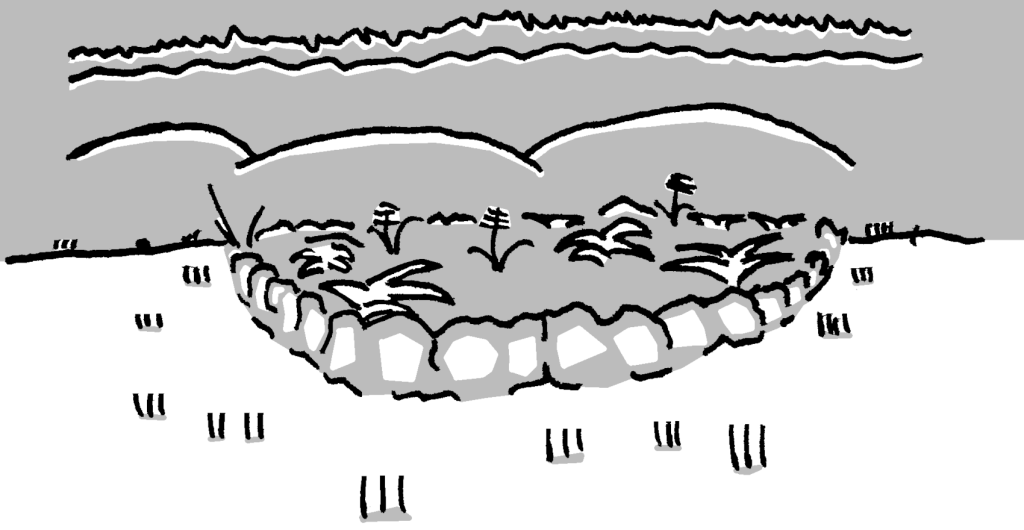
Doogan worked well that day, keeping the land around the village clear. He made no complaint about the knocking, as he assumed it was just harmless mischief for the newcomer. The day ended and the steward was pleased with him and wished him a good night’s rest. Doogan went to bed that night but again the knocking persisted. When he got up to look out the window the knocking ceased but nothing was there but moonlit grass.
This happened again on the third night and that morning Doogan, figuring he had earned enough of the steward’s respect to voice his complaint, asked the steward to take care of this disturbance.
The steward spoke to the neighbours but none had any idea what the noise could have been, and none of them heard it themselves.
“This is strange,” said the steward to Doogan. “I remember something that happened here when I was a boy. A man came to our village and took up some trade or another. He his work poorly and he grumbled. He also complained about a knock in the night which no one else heard. Weeks and weeks passed. At last, before the knock could drive him mad, he was visited by the wife that he had abandoned and in a fit of rage she gave him his death blow.”
Doogan laughed. “I’ve left no woman behind anywhere, I promise you. But where did that knock come from?”
“I never learned,” said the steward. “My father was on good terms with the reeve of Lysseus and asked his advise. An answer came some time later but by then the visitor was dead and his wife locked away. With no one else bothered by the knock, we all forgot about it. Maybe the reeve can tell us again.”
So the steward sent a letter to the reeve’s office and they waited. Weeks and weeks passed. During that time Doogan grew used to the knock and he learned to sleep through it. A day came when Doogan was out mowing the fields and a furious woman jumped out from a thicket and attacked him. Doogan resisted her and managed to flee back to the village but a group of lawmen awaited him there and they took both Doogan and the woman away.
The steward confronted the lawmen and said, “That is my best mower you’re taking away! What are you doing? Release Doogan right now!”
The lawman sergeant said, “This man is a counterfeiter who cheated hundreds out of their savings. This woman is one of his victims. He is to be tried in the city. If he is found innocent then we will release him to you.”
The steward heard nothing of Doogan ever again but a few days later a message came from the reeve’s office in Lysseus. It contained only a quick message of goodwill to the steward and a copy of the following tale.
It read,
A true tale of Ansyne, Mirror Bright of Heaven’s Charms, Holder of a thousand hearts, Whom all the world would win.
Madawar was the greatest knight of his time. His fame spread along Hugwin’s banks. He had wrestled and bested the Yellowmeadow Boar before his first tooth fell out. He had silenced the White Creek Banshee before his first whisker grew. All the heathen assemblies of the north were scattered by his hand before his first grey hair. From his childhood to his twenty-fifth year, tireless Madawar rested not a day until the lands of his birth were cleansed of every wicked creature.
“What is left for me,” he asked, “But to take a worthy woman to be my bride, so that we can enjoy the peace of this land together? But who shall I take?”
Madawar’s squire said, “Noble sir, did we not hear that a woman of surpassing beauty was seen lately travelling toward Trickleside Ground? Was it not said that her face glowed as the gentle moon, so that it might even have been the one they call Ansyne?”
“Ansyne!” Madawar sighed. “Every knight of Geldorad has heard the name, and now she passes by so near as my valorous labours are at last complete. What could it be but fate? But I have heard that the Trickleside Witch still haunts that wilderness. I will rescue her from that troublesome land and take her as my bride.”
So Madawar went and searched Trickleside Ground without luck until only the witch’s house remained. With shield and mighty club at the ready, he knocked on the door and a window on the upper floor flew open. Madawar looked up into Ansyne’s shining eyes and fell deeply in love with her.
He announced, “Worthiest maiden, the knight Madawar who has cleansed these northern lands comes now to take you as his beloved wife and to rescue you from the crooked Trickleside Witch. Open the door to me and I will lead you from this wretched wilderness.”
Ansyne replied, “Worthiest knight Madawar, know that I am quite well and comfortable here. Be on your way and bother me no more.” She closed the window and left.
Madawar knocked again and again until Ansyne returned to the window. He added, “I could never turn my back on so fair and gentle a creature while you languish in a witch’s keeping. Open the door to me and I will overcome her as I overcame countless monsters before her.”
Ansyne replied, “Of all the heathen race, there is none so just and caring as the Trickleside Witch. She hurts no one. She pesters no one. She is a good friend and I am fond of her company.” She closed the window and went away.
Madawar wailed, “What wickedness! I see the witch has already laid her curse on you so that you refuse my good hand! But I will break the spell as I have broken countless others. I shall not cease to call out to you until her enchantment breaks and then you shall open the door to me and be mine! Fear not, fair Ansyne! I will set you free!”
So Madawar called out to Ansyne and knocked without ceasing. He bravely endured perilous nights and violent winds. He pressed on through thirst and aching sores. Though Ansyne begged him to stop and leave, Madawar would not leave her to the witch’s keeping. On the third day the window flew open once more but this time it was not Ansyne but the Trickleside Witch who appeared to him.
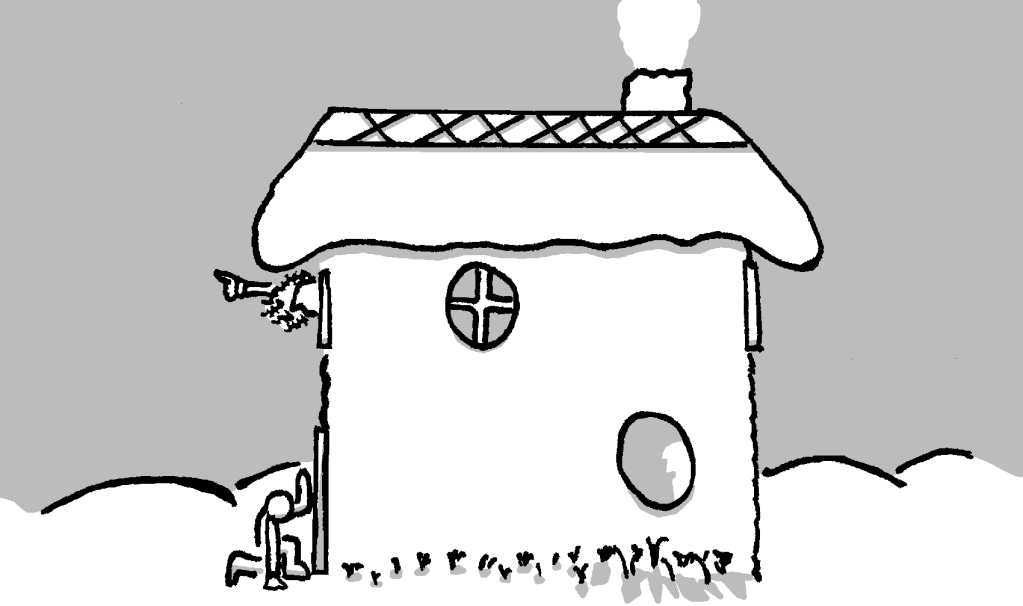
She screeched “Cease that infernal knocking! You have ruined my tea time, spoiled my knitting, and interrupted my gossip! You should have obeyed Ansyne, who begs me to spare your life! But this I do – I lay my curse on you so that your own knock will resound in your ears the rest of your days. And any who travel this way having wronged womankind will hear your knocking also and learn to curse your name to the end of time!”
As he listened to these words, a great thumping resounded in Madawar’s head. The sound overwhelmed him and he could no longer think straight. He ordered his squire to summon his hosts and as he waited he pounded ever on the door. But the knock in Madawar’s own head went on even when he rested.
His hosts arrived and in a fit of fury he ordered, “Bring this awful house down! Let nothing be left standing and slay that terrible witch!”
His hosts did as he commanded. They broke windows, smashed doors, torched the roof, and chiselled the stone walls to dust. The razed the house and brought it down to the foundation. They broke the teacups, tore up clothing, and burned the furniture. At last they brought the Trickleside Witch before Madawar and slew her. Still, the knocking would not stop. He stuffed his ears and clutched his head but without success.
Some in Madawar’s host saw Ansyne in the distance, fleeing in panic and fear. She no longer had any reason to visit Trickleside Ground and was not seen there again. As for Madawar, he took ill in the coming days and was confined to a carehouse where he was treated with the greatest honour until the day the knocking ended.
So read the tale of Madawar.
The steward finished reading this tale and for a time he sat on his chair with a heavy heart. He decided to share it the next day and the other villagers listened in discomfort. As the tale spread, many began avoiding Trickleside Village and it waned. When only twenty old villagers remained, including the steward, they went together to Lysseus to live the rest of their days there. In the years that followed, the houses grew old and crumbled until no sign of their being there remained but a single foundation which is said to stand there still.
Few go there to see it for fear that they should hear knocking while passing through Trickleside Ground.
So, Arturo, if you took the tale of Madawar in isolation you might find yourself admiring Madawar. The tale begins with his accomplishments and in the middle we are led to admire his perseverance, if nothing else. And with only a few small changes we might consider Ansyne a true victim of the witch and Madawar’s curse a noble sacrifice. Perhaps.
I can read no such subtleties into the first tale.
You can treat that distinction however you wish in your songs. I will be happy to hear what you come up with, and happy to send you more inspiration if wanted.
Best regards and happy writing,
Sidwid.


Leave a Reply